
:quality(60)/https://image.triplihotels.com/india/destinations/covers/WhatsApp Image 2026-08-08 at 10.26.51 AM.jpeg)
:quality(60)/https://image.triplihotels.com/india/destinations/manali.png)
:quality(60)/https://image.triplihotels.com/india/destinations/udaipur.png)
:quality(60)/https://image.triplihotels.com/india/destinations/rishikesh.png)
:quality(60)/https://image.triplihotels.com/india/destinations/varanasi.png)
:quality(60)/https://image.triplihotels.com/india/destinations/dharamshala.png)
:quality(60)/https://image.triplihotels.com/india/destinations/mussoorie.jpg)
:quality(60)/https://image.triplihotels.com/india/destinations/Shimlabanner.jpg.jpeg)
:quality(60)/https://image.triplihotels.com/india/destinations/covers/vrindavan.jpg)
.jpg)
:quality(80)/https://image.triplihotels.com/india/blogs/covers/varanasi-in-48-hours-a-complete-itinerary-for-first-time-vis-rcum.webp)
Varanasi is the oldest continuously inhabited city on earth. Mark Twain said it was older than history, older than tradition, older even than legend. You feel that weight from the moment you arrive. It is loud, smoky, chaotic, ancient, and breathtakingly beautiful all at once. There is nowhere else like it.
If you're visiting for the first time and only have 48 hours, this guide is for you. It won't cover everything — nothing could — but it will make sure you don't miss what matters.
DAY 1 — Arrive, Surrender, and Let the Ghats Do the Rest
Morning — Walk the ghats
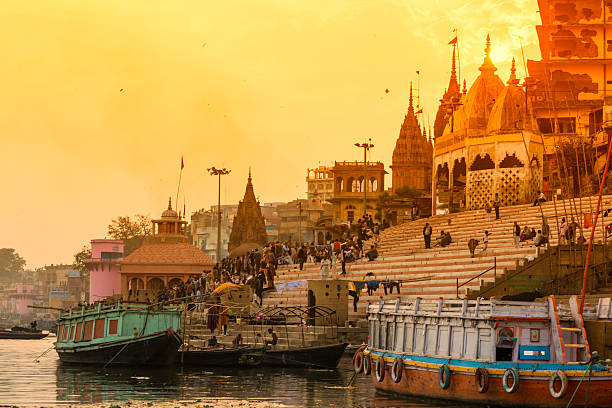
Drop your bags at Tripli Hotel and resist every urge to rest. Varanasi rewards the bold. The ghats — the long stone staircases that descend into the Ganga — are best in the morning when mist still sits low on the water and everything moves slowly.
Take an auto to Assi Ghat, the southernmost of the main ghats, and start walking north. No agenda, no ticket counter. Just you and the river and the incredible pageant of life happening in every direction — a pandit doing puja on a stone platform, a family of pilgrims wading into the water, a man doing yoga, goats wandering through everything like they own the place.
Tripli tip: Wear comfortable shoes you don't mind getting grimy. The ghats are beautiful but the lanes between them are narrow, ancient, and occasionally shared with cows.
Mid-Morning — Boat ride on the Ganga
Somewhere between Assi and Dashashwamedh, hire a wooden rowboat and get on the river. This is non-negotiable. You cannot understand Varanasi from the shore — you need to see it from the water, floating past 87 ghats as the city rises in layers behind the steps.
Your boatman will likely offer a full tour. Take it. The ride usually costs ₹300–500 for an hour and is worth every rupee. Manikarnika Ghat, the main cremation ghat, will come mid-ride. Let yourself take it in. Varanasi has a very different relationship with death than anywhere you've been, and watching pyres burn on the open ghat surrounded by quiet, chanting crowds feels more like a lesson than a tourist sight.
Afternoon — Get lost in the old city lanes
Come back to shore at Dashashwamedh and walk into the lanes behind it. Varanasi's old city — the galiyaan — is a maze by design, and the best thing you can do is put Google Maps away entirely and just wander.
You'll find tiny temples wedged between sweet shops, silk weavers working handlooms in dim rooms, chai stalls where old men argue about cricket, and vendors selling marigolds by the kilo. There's a famous place called Blue Lassi near Vishwanath Gali that has been serving thick, fruit-topped lassi in clay pots since 1936. Queue for it. Worth it.
Eat here: Lunch at Kashi Chat Bhandar near Godowlia for tamatar chaat and kachori. Standing room only, completely unglamorous, absolutely brilliant.
Evening — The Ganga Aarti at Dashashwamedh
This is the moment Varanasi is most famous for, and it earns every word written about it. Every evening at sunset, seven priests in silk robes perform a choreographed fire ritual on the main steps of Dashashwamedh Ghat — lamps, conch shells, incense, synchronized chanting — with hundreds of boats packed with onlookers on the river and thousands more crowding the steps.
Arrive at least 45 minutes early. When it begins — and you'll know, because the energy in the crowd shifts completely — put your phone down for a few minutes and just watch. The whole thing builds over 45 minutes to a sensory crescendo that is genuinely hard to describe.
For a different view: Book a boat on the river during the aarti. Floating on the Ganga looking back at the lit-up ghats while the ceremony unfolds is a perspective no photograph can capture.
Night — Dinner with a view
After the aarti, eat at one of the rooftop restaurants overlooking the ghats. Order baati chokha if you see it — rustic, filling, and deeply local. Then walk back through the lanes if you have the energy. Varanasi at night is quieter but never silent. The temples keep their own hours.
DAY 2 — Sunrise, Sarnath, Silk, and a Slow Goodbye
Pre-Dawn — Wake up before sunrise. Yes, really.
Set your alarm for 5am. You can sleep on the train home.
Sunrise on the Ganga is one of those things that turns even committed non-morning people into temporary converts. The light comes up over the flat eastern bank and hits the ghats in long gold horizontals, gradually illuminating a city that has already been awake for hours — pilgrims bathing, priests chanting, dhobis slapping wet clothes against stone. Take another boat ride. Different time of day, completely different city.
Morning — Kashi Vishwanath Temple
The Kashi Vishwanath Temple, one of the twelve Jyotirlingas of Shiva, opens at 3am, but 6–8am is when the energy is most alive without being totally overwhelming. Note: mobiles are not permitted inside. Leave them at the locker counters provided. Also leave all leather items — belts, wallets, bags — outside. Go with bare feet and no fixed expectations. It is more visceral than a standard temple visit. It is something else entirely.
Late Morning — Sarnath
About 10km from the city centre is Sarnath, one of the most important Buddhist pilgrimage sites in the world. This is where the Buddha delivered his first sermon after attaining enlightenment. The Deer Park is still here. The Dhamek Stupa, built in 500 AD, anchors the site. The Archaeological Museum next door holds the original Lion Capital of Ashoka — India's national emblem — and it is extraordinary to stand in front of it.
Sarnath has a completely different texture from Varanasi. Calm, green, quiet. After the intensity of the ghats, it is a welcome contrast. An auto from the city costs around ₹200 one-way. Allow at least two hours.
Afternoon — Banarasi silk shopping
Varanasi is the home of Banarasi silk — the heavy, gold-zari embroidered fabric woven here for centuries and considered the finest textile in India. If you want to buy a saree, a stole, or fabric by the metre, this is the place. The government emporium on Chaitganj is a safe starting point if you want to avoid being sold machine-made cloth at handloom prices. Established shops around Vishwanath Gali are also reliable.
A word of caution: If someone on the street enthusiastically invites you to their "uncle's silk factory," that's a commission detour. Go on your own terms.
Final Hours — One last chai, then let go
Before you leave, go back to the ghats. It takes five minutes and you'll be glad you did. Sit somewhere and have a cup of chai — it'll cost ₹10, come in a small clay cup, and taste better than anything you've had in months. Watch the river. Varanasi has been moving at its own pace for three thousand years, and whatever noise you brought here with you tends to feel smaller by the time you leave. That's not mystical. That's just what this city does.
48 hours is not enough time to understand Varanasi. But it is enough time to be changed by it. Go with curiosity, go with patience, and go without a rigid schedule. The city will fill the gaps better than any itinerary can.
See you on the ghats.
A Tripli Hotel Travel Guide — Varanasi, Uttar Pradesh